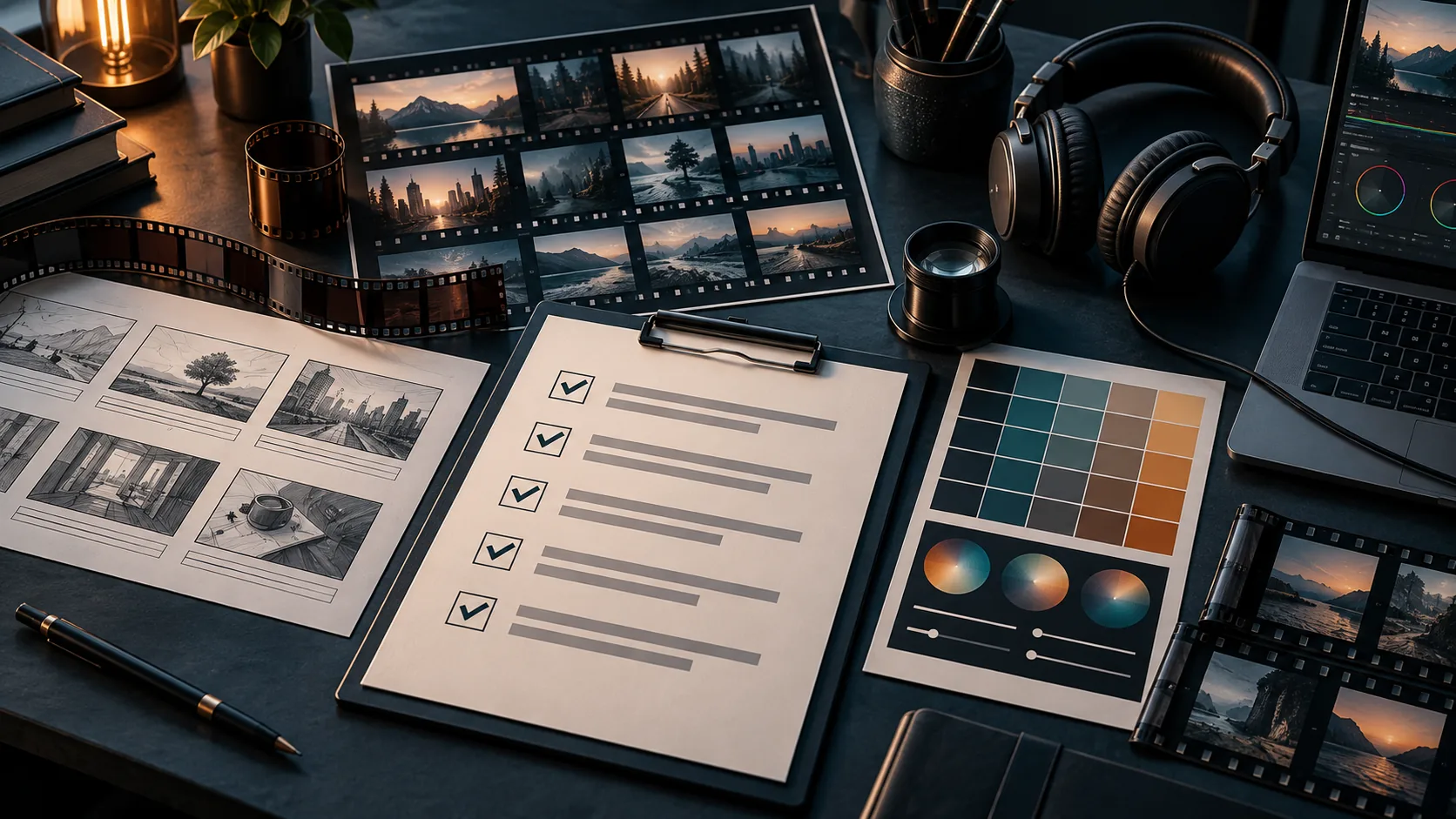
Buyer checklist · Published
Video Editor Portfolio Checklist: 12 Tests Before You Hire
A practical way to separate relevant evidence from an impressive reel, expose gaps before you commit and turn a shortlist into a fair hiring decision.
Affiliate disclosure: HireVerdict may earn a commission if you buy through the Fiverr link above, at no extra cost to you. Placement does not change our checklist. Read the full disclosure.
Quick answer
A portfolio is evidence, not a verdict
Evaluate a video editor portfolio against your actual format, audience and constraints. Confirm what the editor personally did, review complete pieces for story, audio and consistency, then list what remains unproven. Use questions and a small paid test to close those gaps before you award larger work.
Define the evidence you need before opening portfolios
A portfolio cannot be relevant until the job is defined. Write a one-paragraph brief covering the finished format, approximate duration, audience, channel, source assets, brand references, recurring volume, review process and required handoff. If you need help, use the video editor project brief template.
Then separate requirements into three buckets:
Must prove now
Capabilities that decide whether the editor can do the job, such as dialogue pacing or accurate captions.
Can verify by question
Process details that may not be visible, such as feedback handling, archive delivery or availability.
Can verify by paid test
Your brand-specific judgment, collaboration and treatment of your real source material.
The checklist
12 video editor portfolio checks
Use the same checks for every candidate. Record a short note beside each one; otherwise a strong first impression can silently become the whole decision.
- 1
Relevant format
Does the portfolio include the format you are buying?
Match short-form, long-form, interview, product, course or corporate work to your actual deliverable. A polished music montage is weak evidence for a dialogue-led training video.
- 2
Clear contribution
Can the editor explain exactly what they handled?
Ask whether they edited the piece, selected takes, mixed audio, created motion graphics, sourced footage, wrote captions or only completed one part of the workflow.
- 3
Story and pacing
Does the edit make the message easier to follow?
Watch once without pausing. Note whether the opening establishes context, transitions feel intentional and the ending lands cleanly instead of stopping abruptly.
- 4
Audio judgment
Is speech consistently understandable?
Listen for balanced voices, controlled background music, clean transitions and sensible treatment of imperfect source audio. Use ordinary headphones and speakers, not just studio monitors.
- 5
Visual continuity
Do cuts, color and framing feel coherent?
Check for distracting jumps, mismatched color, accidental black frames, unstable crops and inconsistent placement of recurring elements.
- 6
Text and captions
Are on-screen words readable and accurate?
Review caption timing, spelling, line breaks, safe placement, contrast and whether typography follows one repeatable system.
- 7
Graphics restraint
Do effects support the message?
Look for purposeful titles, callouts and transitions. More animation is not automatically better; the relevant question is whether the treatment fits your brand and audience.
- 8
Platform fit
Does the work respect its intended viewing environment?
Check aspect ratio, opening pace, caption treatment, thumbnail-safe framing and whether important information survives small-screen viewing when that matters for your channel.
- 9
Consistency across samples
Can the editor repeat the standard?
Compare several relevant pieces. One exceptional sample may involve a different team, a larger budget or unusually clean footage; a coherent set is more useful evidence.
- 10
Constraints and trade-offs
Can the editor describe what made the work difficult?
Ask what source material they received, what they changed after feedback and what they would improve with more time. Specific answers reveal process better than adjectives.
- 11
Rights and privacy
Are ownership and permissions clear enough to discuss?
Do not assume a public sample proves permission to reuse footage, music, logos or client information. Ask how assets were licensed and whether confidential work can be discussed only in general terms.
- 12
Evidence gaps
What important capability is still unproven?
Write down the missing evidence: your niche, your source quality, your turnaround needs, collaboration or file handoff. Plan questions or a small paid test around those gaps.
Use a red–amber–green portfolio scorecard
Do not pretend a portfolio review is precise measurement. A simple evidence label keeps uncertainty visible while making candidates easier to compare.
| Label | Meaning | Next action |
|---|---|---|
| Green | Several relevant samples show the capability, and the editor’s contribution is clear. | Confirm the process and scope in writing. |
| Amber | The work is adjacent, evidence is thin or the contribution is unclear. | Ask one focused question or test the capability. |
| Red | Relevant evidence conflicts with the requirement, or a must-have is absent. | Remove the candidate unless the requirement can change. |
| Unknown | The portfolio cannot answer the question. | Do not convert missing evidence into a positive or negative assumption. |
Editorial-method label: This scorecard is HireVerdict’s qualitative comparison framework. It is not a performance score, provider ranking or statistical model.
Questions that turn portfolio claims into usable evidence
Good questions ask for a concrete example, input or decision. They are more revealing than asking whether someone is “detail-oriented” or “good with feedback.”
- Which sample is closest to my project, and what parts did you personally complete?
- What source files and direction did you receive for that sample?
- What changed between the first cut and the approved version?
- How do you handle incomplete footage, noisy audio or missing brand assets?
- How do you collect feedback and identify conflicting revision notes?
- What files, project archives or usage notes are included at handoff?
Compare the answers with your video editing budget assumptions. A portfolio may justify a larger scope, but it does not prove a live price. Ask current candidates to quote against the same brief so the comparison is like-for-like.
Close the biggest evidence gap with a small paid test
A paid test is useful when the portfolio is relevant but cannot show how the editor handles your footage, brand rules or feedback. It should be real enough to evaluate and small enough to discard if the fit is wrong.
- 01
Choose one representative task
Use a short segment with the same audience, source quality and editorial problem as the recurring work.
- 02
Provide a mini brief
State the objective, deliverable, references, required assets, deadline, revision boundary and handoff format.
- 03
Define the review signals
Evaluate interpretation of the brief, communication, editorial judgment, technical finish and file hygiene—not whether the editor guessed an unstated preference.
- 04
Pay and compare fairly
Give shortlisted editors the same source package and evaluation criteria. Do not ask for free speculative work.
- 05
Record the decision
Save the evidence labels, open risks and agreed working process so the full project starts from shared expectations.
Match your portfolio search to the project
These Fiverr category links keep the same HireVerdict affiliate identity while narrowing the destination by format. Search results, availability and prices can change; apply the same checklist to any candidate you consider.
Affiliate disclosure: HireVerdict may earn a commission from qualifying Fiverr purchases through these links, at no extra cost to you. We do not rank or endorse individual sellers here.
Portfolio review mistakes to avoid
Choosing the flashiest reel
A fast montage can hide weak narrative, audio or full-project consistency.
Rewarding irrelevant polish
High production value in the wrong format may not answer your buying question.
Ignoring the editor’s role
A finished piece may reflect a director, animator, sound mixer or team. Clarify contribution.
Treating missing evidence as failure
Confidential work and new specialties can create gaps. Verify with questions or a paid test.
Using different standards
Changing criteria from candidate to candidate makes the decision harder to defend.
Skipping handoff evidence
A strong cut is only part of the job if you also need archives, source organization or templates.
Video editor portfolio checklist: final decision
Choose the candidate with the clearest relevant evidence and the most manageable remaining risks—not automatically the largest portfolio. Move the promises that matter into a written scope: deliverables, milestones, review rounds, asset responsibilities, handoff and ownership terms.
For the full hiring sequence, use the HireVerdict video editor hiring guide. To understand how we evaluate services without pretending to test every seller, read our methodology.
Frequently asked questions
What should I look for in a video editor portfolio?
Look for work that matches your format, audience and production constraints; then assess story clarity, audio, continuity, text, platform fit and consistency across several samples. Confirm the editor’s exact contribution and note every capability the portfolio does not prove. A relevant, repeatable process matters more than a flashy but unrelated reel.
How many portfolio samples should I review?
Review enough relevant samples to see a pattern rather than relying on one showpiece. HireVerdict does not treat a fixed sample count as a marketplace rule. If the available work is sparse, ask focused questions and use a small paid test instead of assuming missing evidence is either good or bad.
Is a showreel enough to choose a video editor?
Usually not by itself. A showreel can demonstrate taste and range, but short highlights hide narrative structure, audio consistency, caption accuracy and how an editor handles an entire deliverable. Ask for complete examples close to your format and clarify the editor’s contribution to each one.
Should I ask for a free video editing test?
Prefer a small paid test with a written scope, supplied assets, a clear deadline and agreed handoff. That creates a fairer evaluation of communication and process without asking a freelancer to produce speculative work for free. The test should represent the recurring work without exposing unnecessary confidential material.
Can a portfolio prove that an editor will meet my deadline?
No. A portfolio shows outputs, not delivery reliability. Ask how timelines are planned, what inputs must arrive before work starts, how delays are communicated and whether the editor has capacity for your schedule. Put milestones and review windows in the project brief rather than inferring them from visual quality.
How this guide was produced
Transparent editorial method
HireVerdict created this checklist by translating the site’s existing buyer framework—scope clarity, proof, constraints, communication, rights and handoff—into a portfolio-review sequence. It is editorial synthesis, not a Fiverr dataset, seller ranking, marketplace average or claim that we tested individual providers.
All planning ranges and scope suggestions are labeled as estimates. We do not invent current prices, review scores, delivery results or seller performance. Verify live listings, terms and quotes before purchasing. See the full methodology and Fiverr platform guide.